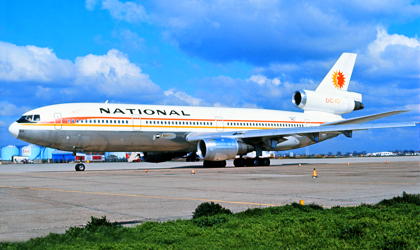
Douglas DC-10 International Fleet:
- Canada (C)
- Chile (CC)
- Denmark (OY)
- Finland (OH)
- France (F)
- Germany (D)
- Iceland (TF)
- Indonesia (PK)
- Japan (JA)
- Malaysia (9M)
- Netherlands (PH)
- New Zealand (ZK)
- Norway (LN)
- Pakistan (AP)
- Philippines (RP)
- Sweden (SE)
- Thailand (HS)
- United Kingdom (G)
- United States (N)
- Yugoslavia (YU)
Background Information.
Following an unsuccessful proposal for the United States Air Force's CX-HLS (Heavy Logistics System) in 1965, Douglas began design studies based on its CX-HLS design. In 1966 American Airlines issued a proposal to manufacturers for a widebody aircraft smaller than the Boeing 747 but capable of flying similar long-range routes from airports with shorter runways. The DC-10 became McDonnell Douglas's first commercial airliner after the merger between McDonnell Aircraft Corporation and Douglas Aircraft Company in 1967. An early DC-10 design proposal was for a four-engine double-deck wide-body jet airliner with a maximum seating capacity of 550 passengers that was similar in length to the DC-8. The proposal was shelved in favour of a trijet single-deck wide-body airliner with a maximum seating capacity of 399 passengers, and similar in length to the DC-8 Super 60.
On February 19, 1968, in what was supposed to be a knockout blow to the competing Lockheed 1011 Tristar, George A. Spater, President of American Airlines, and James S. McDonnell of McDonnell Douglas announced American Airlines' intention to acquire the DC-10. This was a shock to Lockheed and there was general agreement within the U. S. aviation industry that American Airlines had left its competitors at the starting gate. Together with American Airlines' decision to announce the DC-10 order, it was also reported that American Airlines had declared its intention to have the British Rolls-Royce RB211 turbofan engine on its DC-10 aircraft.
The DC-10 was first ordered by launch customers American Airlines with 25 orders and United Airlines with 30 orders and 30 options in 1968. The first DC-10, a series 10, made its maiden flight on August 29, 1970. Following a test program with 929 flights covering 1,551 hours, the DC-10 received its type certificate from the FAA on July 29, 1971. It entered commercial service with American Airlines on August 05, 1971 on a round trip flight between Los Angeles and Chicago. United Airlines commenced DC-10 services in mid-August.
American's DC-10s had 206 seats and United's had 222, both had six-across seating in first-class and eight-across (four pairs) in economy class. The DC-10's similarity to the Lockheed Tistar in design, passenger capacity and launch date resulted in a sales competition that affected profitability of the aircraft.
The first DC-10 version was the ‘domestic’ series 10 with a range of 3,800 miles (3,300 nm or 6,110 km) with a typical passenger load or a range of 2,710 miles (2,350 nm or 4,360 km) with maximum payload. The series 15 had a typical load range of 4,350 miles (3,780 nm or 7,000 km).
The DC-10 series 20 was powered by Pratt & Whitney JTD9 turbofan engines, whereas the series 10 and 30s were powered by General Electric CF6 engines. Before delivery of its aircraft, Northwest's president asked that the ‘series 20’ aircraft be redesignated ‘series 40’ because the aircraft was much improved over the original design. The FAA certified the DC-10-40 on October 27, 1972.
The series 30 and 40 were the longer-range ‘international’ versions. The main visible difference between the models is that the series 10 has three sets of landing gear (one front and two main) while the series 30 and 40 have an additional centerline main gear. The centre main two-wheel landing gear (which extends from the centre of the fuselage) was added to distribute the extra weight and for additional braking. The series 30 had a typical load range of 6,220 mi (10,010 km) and a maximum payload range of 4,604 mi (7,410 km). The series 40 had a typical load range of 5,750 miles (9,265 km) and a maximum payload range of 4,030 miles (3,500 nm or 6,490 km).
The DC-10 had two engine options and introduced longer-range variants a few years after entering service, thus allowed it to distinguish itself from its main competitor, the Lockheed Tristar. The 446th and final DC-10 was rolled off the Long Beach, California Products Division production line in December 1988 and was delivered to Nigeria Airways in July 1989. The production run exceeded the 1971 estimate of 438 deliveries needed to break even on the project. As the final DC-10s were delivered McDonnell Douglas had started production of its successor, the MD-11.
As more orders for the DC-10 were received, McDonnell Douglas used the time gained before the end of DC-10 production to consult with potential customers and to refine the proposed new trijet. In July 1985, the Board of Directors authorized the Long Beach plant to offer the MD-11 to potential customers. At the time, the aircraft was offered in two versions, both with the same fuselage length, a stretch of 22 ft 3 in (6.78 m) over the DC-10 airframe, as well as the same engine choice as the MD-11X.
One version would have a range of 4,780 nautical miles (8,850 km) with a gross weight of 500,000 pounds (230,000 kg) and accommodate up to 337 passengers. The second version would carry 331 passengers over a distance of 6,900 nautical miles (12,800 km). A year later, as several airlines had committed to the MD-11, the situation was looking optimistic. The aircraft was now defined as a 320-seater with an 18 ft 7 in (5.66 m) stretch over the DC-10-30 and powered by the new advanced turbofans offered by the major engine manufacturers, giving it a range of 6,800 nautical miles (12,600 km).
Other models were proposed, such as a shortened ‘ER’ model with a range of 7,500 nautical miles (13,900 km), an all-cargo version offering a maximum payload of 200,970 pounds (91,160 kg) and a Combi with a provision for ten freight pallets on the main deck. Further growth of the aircraft was also foreseen, such as the MD-11 Advanced. The MD-11 has a centre engine at the base of the vertical stabilizer, like the DC-10. Like the DC-10-40, the nacelle has a bulge at the front.
The lack of innovation from McDonnell Douglas during the MD-11's design had been attributed to the company's declining cash flow, as it struggled with problems with its military contracts and declining orders for its commercial jets. Limited company resources resulting in the MD-11 being developed as a refinement of the existing DC-10, in contrast to rivals Airbus and Boeing who during this time period developed all-new aircraft designs that would become the Airbus A330/A340 and Boeing 777.
As a trijet the MD-11 was less fuel-efficient but had a greater range than its mid-size widebody contemporaries twinjets, the existing Boeing 767 and upcoming Airbus A330. Aerospace consultant Scott Hamilton, in a 2014 article, said that the MD-11 was ‘classically ill-timed as it came at the end of the three- or four-engine era, just ahead of the real move to EFTOPS with the Boeing 777’. McDonnell Douglas's initiative to ‘outsource everything but design, final assembly, and flight testing and sales of the MD-11’ was also seen as contributing to the end of their commercial airline business.
On December 30, 1986, McDonnell Douglas launched the MD-11 with commitments for 52 firm orders and 40 options in three different versions (passenger, combi and freighter) from ten airlines.
The first MD-11 was delivered to Finnair on December 7, 1990. It operated its first revenue service on December 20, 1990, carrying passengers from Helsinki to Tenerife in the Canary Islands. MD-11 service in the U.S. was inaugurated by Delta Air Lines the following year.
It was during this period that flaws in the MD-11's performance became apparent. It failed to meet its targets for range and fuel burn. Ameican Airlines in particular was unimpressed with the 19 MD-11s that it received, as was Singapore Airlines, who cancelled their order for 20 MD-11s and instead ordered 20 Airbus A340-300s. American Airlines cited problems with the performance of the engines and airframe, while Singapore Airlines stated that the MD-11 could not operate on the airline's long haul routes. Pre-flight estimates indicated that the P&W-powered MD-11 was to have a 7,000 nautical miles (13,000 km) range with 61,000 pounds (28,000 kg) of payload. With the Phase 1 drag reduction in place then, the aircraft could only achieve its full range with 48,500 pounds (22,000 kg) of payload, or a reduced range of 6,493 nautical miles (12,025 km) with a full payload.
In 1990, McDonnell Douglas, along with Pratt & Whitney and General Electric began a modification program known as the Performance Improvement Program (PIP) to improve the aircraft's weight, fuel capacity, engine performance and aerodynamics. McDonnell Douglas worked with NASA's Langley Research Center to study aerodynamic improvements. The PIP lasted until 1995 and recovered the range for the aircraft. However by this point, sales of the MD-11 had already been significantly impacted. In 1995 American Airlines sold their 19 MD-11s to FedEx, as the PIP program was not sufficient for the aircraft to fly the Dallas Fort Worth - Hong Kong route.
After McDonnell Douglas merged with Boeing in 1997, the newly unified company decided that MD-11 production would continue exclusively with the freighter variant. In 1998, Boeing announced they would end MD-11 production after filling orders on hand. The last passenger MD-11 built was delivered to Sabena in April 1998. Assembly of the last two MD-11s were completed in August and October 2000, they were delivered to Lufthansa Cargo on January 25, and February 22, 2001 respectively. Production ended because of lack of sales, resulting from internal competition from the Boeing 777 as well as external competition from the Airbus A330 / A340.